

Somewhere over Pakistan right now, a few hundred kilometres up, several thousand refrigerator-sized satellites are travelling at ~27,000 km/h, each one overhead for about 4 minutes before the next takes over. Currently, they can’t provide internet to your houses and offices but soon enough, that will change.
Why it matters: How satellite internet eventually shapes up in Pakistan probably depends less on technology and more on the choices those in power end up making. And with those decisions being made as we speak, it’s a good moment to take stock.
The physics: Geostationary satellites sit ~36,000km up, and round-trip latency often clears 250 milliseconds. Past 110ms, voice usually gets shaky and for interactive internet, the experience falls apart. The obvious fix is to fly lower. Starlink orbits at around 550 km, fast enough to lap the Earth every 95 minutes. That is exactly what made low-earth orbit broadband technically possible but commercially hopeless for decades: nobody could launch, maintain, and replace that many satellites at a price a consumer would pay.
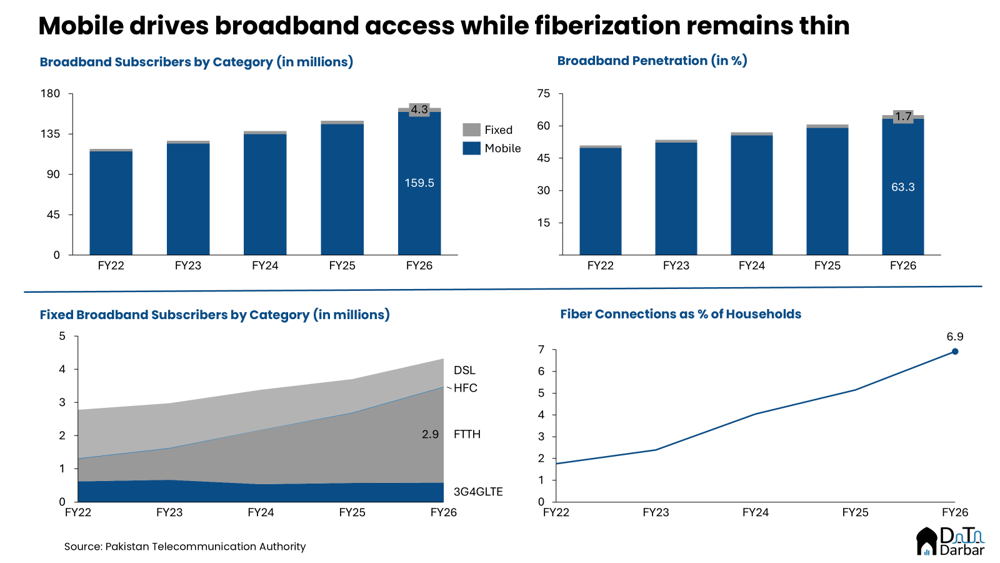
Where it fits: By FY26 end, Pakistan had ~164M broadband connections, of which a majority — 159.5M, or 97% — is through mobile. Fixed makes up just ~4.4M, a bit over a tenth of total households. Within this smaller base, fibre has grown from ~100k connections in FY19 to 2.88M in FY26 — but under 8% households are fiberized.
The economics don’t make much sense: laying fibre to a single home runs somewhere between PKR 60,000 and 120,000. The math only works where incomes and population density are beyond a certain threshold, which typically happen to be the same urban neighbourhoods that are already connected.
Yes, but: Early results suggest a fairly consistent pattern across markets: LEO typically settles in as a complement to terrestrial broadband, not a replacement for it. However, that also depends on the income level.
The holdup: Starlink had gotten its no-objection certificate from PSARB back in March 2025 but that has reportedly been cancelled, as it now awaits the final legal framework from the PSARB. The demands themselves aren’t the sticking point — in-country gateways, data localization and lawful interception have generally been accepted elsewhere, and most countries require versions of them. What’s missing is the rulebook to act on.
The catch: Perhaps even more important than the rules is how they are going to be administered. The PSARB board hands five of eight seats to the security-space establishment, two to civilian ministries, and a grand total of zero to private-sector, academic, or telecom-industry presence. SUPARCO also runs PSARB’s secretariat, in addition to operating PAKSAT and holds the first right of refusal. Essentially, a competitor is now the regulator as well. Bangladesh, by contrast, gave powers to the existing telecom regulator and speed-rolled Starlink’s launch in seven months.
The geopolittical angle: In many markets, Starlink has benefited from diplomatic support by Washington, made possible by Elon Musk’s proximity to the Trump administration. Pakistan, though, is a more complicated case. Historically, Islamabad has leaned towards Beijing, which has its own contender in the pipeline — potentially creating a familiar tightrope act.
Go deeper: Download the full report to understand who the customer is, which players are looking to enter Pakistan, and what LEO means for the incumbents.